On December 28, Xiaomi unveiled the SU7, its first electric vehicle, marking a substantial entry into the rapidly growing electric vehicle market. More information on the SU7 was released by Xiaomi EV, the recently formed division dedicated to producing electric vehicles, establishing it as a formidable rival to some of the world’s leading EV manufacturers.
Lei Jun, the CEO of Xiaomi, emphasizes that the Xiaomi SU7 is not just aimed at competing in the electric vehicle segment but is positioned to match the aesthetics, technology, and performance of well-known electric vehicles, including the Tesla Model S. The launch highlights Xiaomi’s ambitions to expand beyond consumer electronics and become a major player in the automotive industry.
The production of the electric vehicle has already started and is taking place in Beijing at a facility owned by the Chinese automaker BAIC Group. This partnership allows Xiaomi to leverage existing automotive manufacturing expertise while focusing on developing advanced electric mobility solutions.
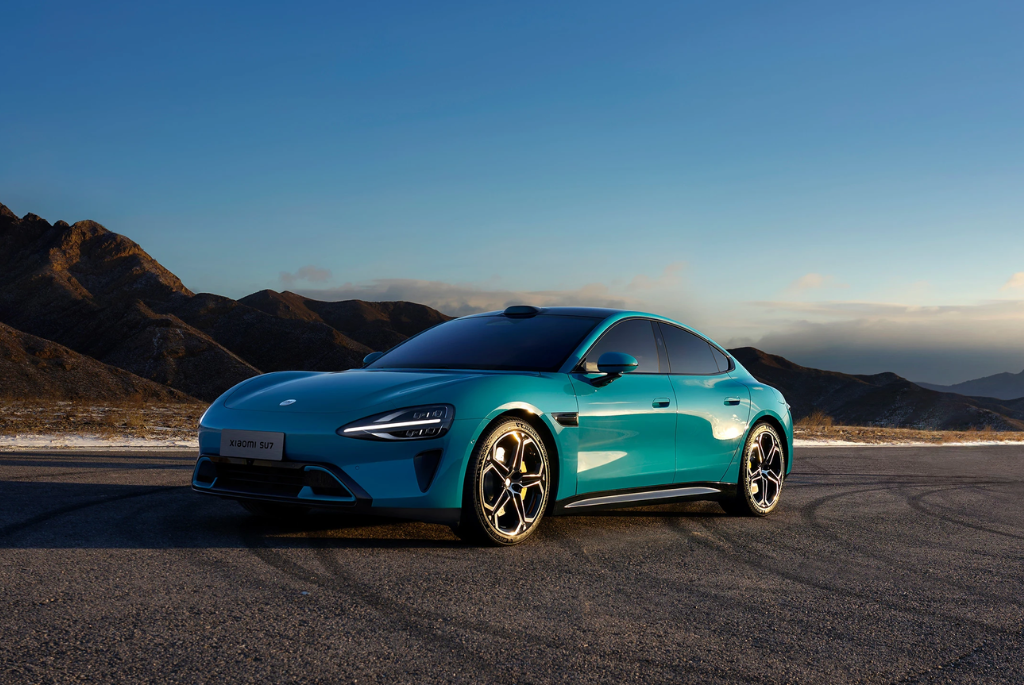
Upon closer inspection, the Xiaomi SU7’s athletic styling is reminiscent of the Porsche Taycan. The SU7 is showcased in official images as a premium sports sedan featuring sleek body lines, a low-slung profile, and several design elements that give it a sophisticated and performance-oriented appearance.
Its attractive appearance is further enhanced by the Aqua Blue exterior colour scheme, which is complemented by stylish alloy wheels and aerodynamic detailing. The overall design reflects Xiaomi’s intention to position the SU7 in the premium electric sedan segment rather than as a budget-oriented offering.
In terms of power, the Xiaomi SU7 base model will feature a 73.6 kWh battery pack, while the premium version will be equipped with a larger 101 kWh battery pack. These battery options are expected to cater to different customer requirements, balancing performance, efficiency, and driving range.
With the launch of its own CTB (Cell-to-Body) technology, Xiaomi has effectively integrated the battery into the vehicle’s structure. This innovation reduces overall height, eliminates the conventional battery floor, and improves structural rigidity. As a result, the cabin becomes more spacious while also enhancing safety and driving dynamics.
The electric car manufacturer predicts that the SU7 will deliver an impressive driving range of up to 800 kilometres on a single charge. Furthermore, Xiaomi has revealed plans to introduce a new battery technology known as the V8 by 2025. This future battery pack is expected to offer a capacity of 150 kWh and an extraordinary range of up to 1,200 kilometres, potentially setting new benchmarks in the EV industry.
Notably, the Xiaomi SU7 electric sedan seeks to compete with some of the world’s fastest electric cars in terms of performance. Xiaomi claims that the EV’s motor technology can achieve speeds of up to 21,000 revolutions per minute (RPM), placing it among the most advanced systems in its category.
The two primary motors currently in production are the V6 and V6S units, which produce power outputs ranging from 299 hp to 374 hp and generate peak torque of up to 635 Nm. These figures indicate strong acceleration and dynamic driving characteristics.
The top speed of the SU7 is anticipated to be 210 kmph for the base model and an impressive 265 kmph for the premium variant. With its combination of long-range capability, innovative battery technology, premium design, and strong performance figures, the Xiaomi SU7 represents a significant milestone in the company’s journey into the electric vehicle market and signals its intent to challenge established global EV manufacturers.
About The Author