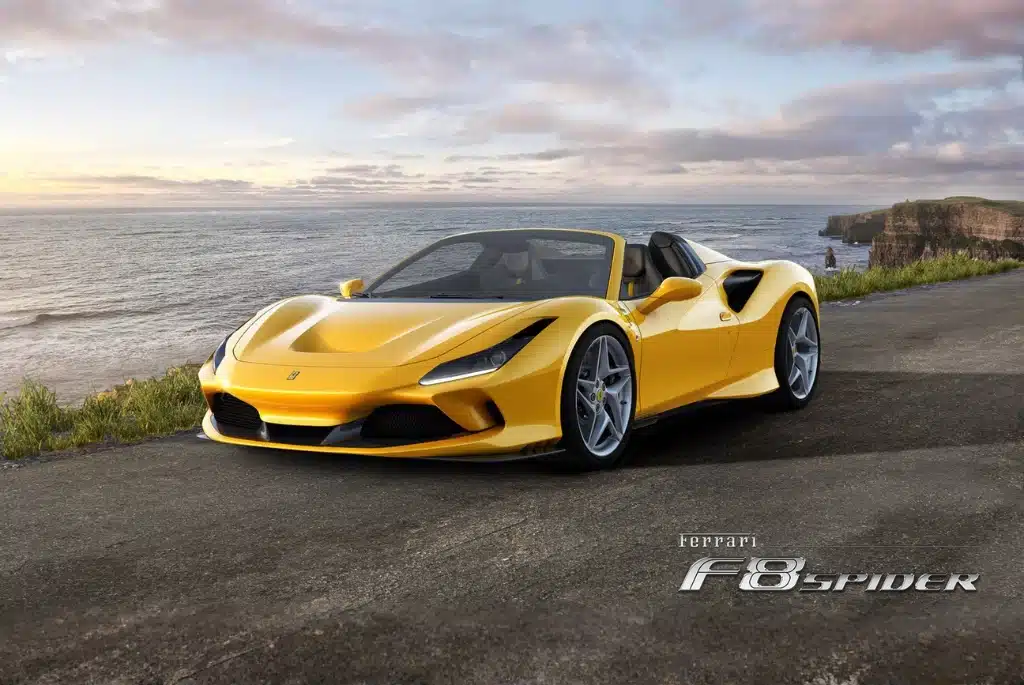
The Ferrari F8 Spider arrived in 2019 as the open-top successor to the Ferrari 488 Spider, bringing the latest development of Ferrari’s mid-engine V8 formula to a convertible body style. It combined a 3.9-litre twin-turbocharged V8, rear-wheel drive, a seven-speed dual-clutch gearbox and an electronically controlled chassis with a retractable hardtop.
The result was a convertible with the performance credentials of a serious supercar and the character of an open-top grand tourer. Ferrari’s official technical data lists 720 cv at 8,000rpm and 770 Nm of torque at 3,250rpm. The Ferrari F8 Spider could accelerate from 0-100 km/h in 2.90 seconds, reach 200 km/h in 8.2 seconds and achieve a top speed of 340 km/h.
More importantly, the F8 Spider represented the highly developed end of Ferrari’s combustion-only mid-engine V8 formula. It took lessons from the 488 family and the track-focused 488 Pista and packaged them into a road-going convertible.
Ferrari F8 Spider: The Evolution of an Open-Top V8
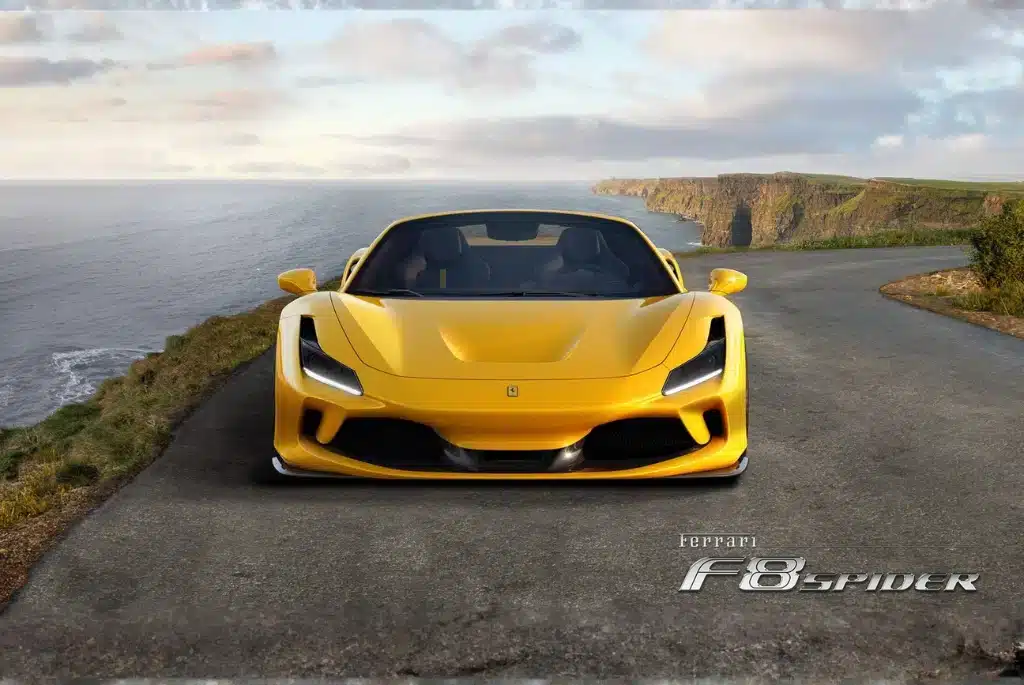
The Ferrari F8 Spider was part of a long line of Ferrari mid-engine V8 sports cars. Its immediate predecessor was the 488 Spider, while the F8 Tributo served as the fixed-roof counterpart.
The F8 generation was introduced as a replacement for the 488 family. Ferrari’s objective was not to reinvent the basic architecture but to refine almost every major area, including the engine, aerodynamics, electronics and weight management.
The 3.9-litre V8 was closely related to the unit used in the 488 Pista. Ferrari revised the engine’s internal components and air-intake system, while the Variable Torque Management system was recalibrated to deliver a broader and more consistent torque curve. MotorTrend reported that the engine benefited from lighter internal components, including a revised crankshaft, flywheel and connecting rods.
The F8 Spider also retained the retractable hardtop concept used by its predecessor. The decision to use a metal roof rather than a fabric system reflected Ferrari’s focus on maintaining refinement with the roof closed.
The Ferrari F8 Spider therefore represented evolution rather than revolution. The underlying formula remained familiar, but Ferrari pushed the platform further in almost every measurable direction.
The timing also made the model significant. Ferrari was already expanding into hybrid performance cars, with the SF90 Stradale occupying a more electrified position in the range. The F8 Spider remained focused entirely on its combustion V8, making it an important representative of Ferrari’s traditional mid-engine supercar architecture.
Design: A Supercar Shaped by Aerodynamics
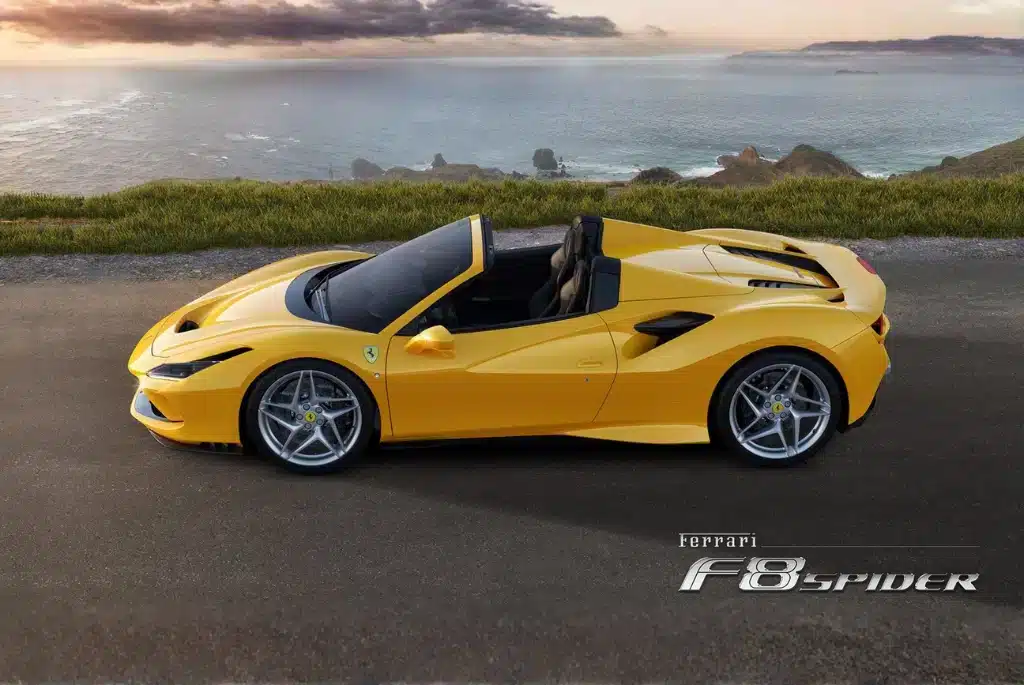
The Ferrari F8 Spider has the proportions expected of a mid-engine Ferrari, but its styling is closely connected to aerodynamic engineering.
The front section is dominated by Ferrari’s S-Duct, a system derived from the 488 Pista. Air entering the front of the car is channelled through the bodywork and redirected over the upper surface, increasing aerodynamic efficiency and downforce.
The design also benefits from compact LED headlights. Their smaller dimensions allowed Ferrari to create a lower and more sculpted front-end treatment, leaving greater freedom for the aerodynamic surfaces beneath and around them.
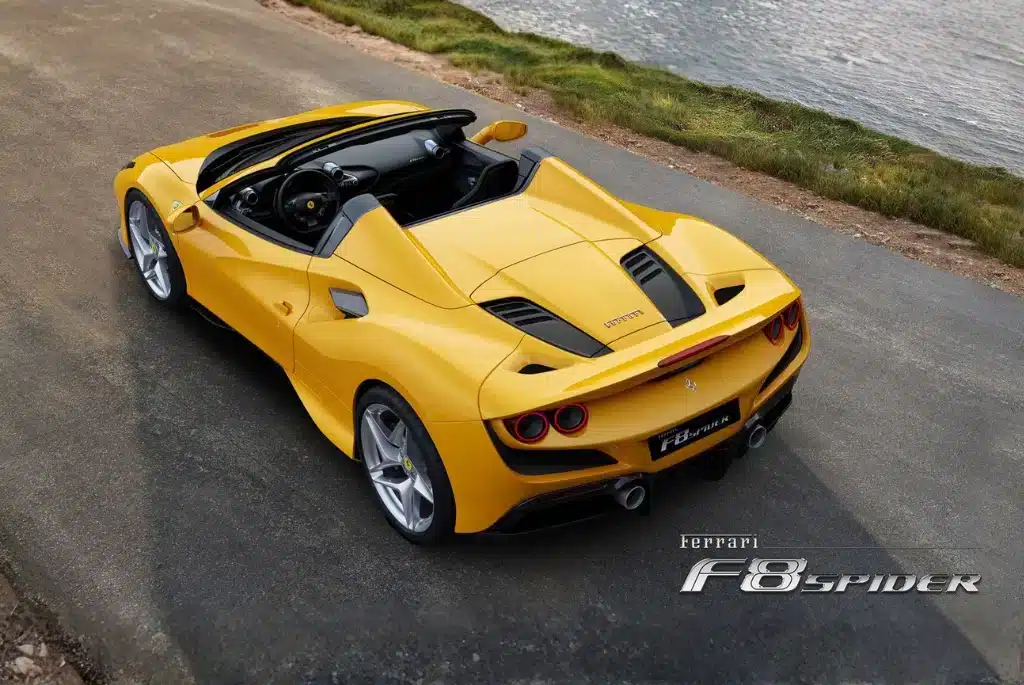
The rear is equally important. A larger rear spoiler sits above the engine compartment, while the rear fascia returns to a twin-taillight design that recalls several classic Ferrari models.
The Ferrari F8 Spider is therefore less dependent on visual aggression than some rivals. Its bodywork remains sculpted and dramatic, but the shapes are primarily driven by airflow and packaging requirements.
The retractable hardtop adds another layer to the design. It is divided into two sections and folds behind the cabin. Ferrari designed the roof mechanism and its surrounding bodywork to maintain the proportions of the car when the roof is raised.
The system takes approximately 14 seconds to operate and can be activated at speeds of up to 45 km/h, or around 28 mph.
With the roof closed, the F8 Spider retains the visual character of a conventional Ferrari supercar. With the roof lowered, the cockpit becomes visually integrated with the rear bodywork, exposing more of the cabin and engine soundtrack to the occupants.
Ferrari’s official figures also show how compact the car is relative to its performance. The F8 Spider measures 4,611mm long, 1,979mm wide and 1,206mm high, with a 2,650mm wheelbase.
The proportions are low and wide, but not excessively large. That compact footprint contributes to the car’s sense of agility.
Ferrari F8 Spider: The 3.9-Litre Twin-Turbo V8
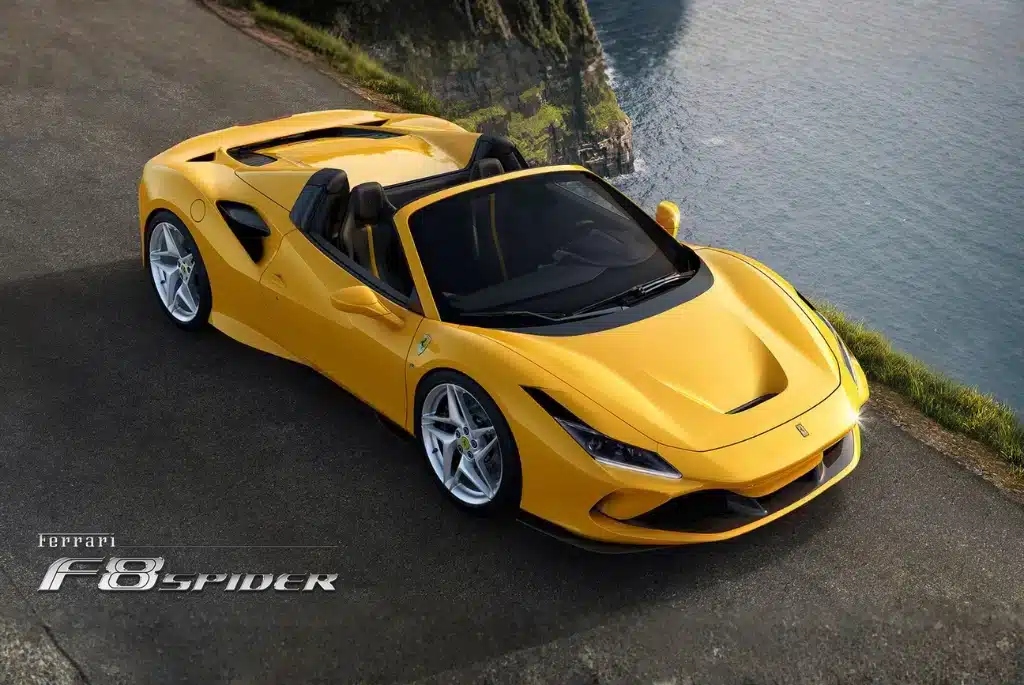
At the centre of the Ferrari F8 Spider is a 3,902cc, 90-degree twin-turbocharged V8 with dry-sump lubrication.
Ferrari’s official specification lists maximum power at 720 cv at 8,000rpm and peak torque of 770 Nm at 3,250rpm. The engine’s specific output is rated at 185 cv per litre, while the maximum engine speed is 8,000rpm.
US automotive publications generally quote the engine at 710 hp and 568 lb-ft of torque. Car and Driver lists the F8 Spider with 710 hp at 8,000rpm and 567 lb-ft at 3,250rpm.
The different published figures reflect the measurement conventions used in different markets, rather than a fundamentally different engine.
Ferrari made extensive changes to the V8 compared with the 488 Spider. MotorTrend reported that the crankshaft, flywheel and connecting rods were lightened, reducing rotational inertia and allowing the engine to respond more quickly. Exhaust manifolds made from Inconel also helped reduce weight.
The intake system was revised as well. Rather than drawing air from the flanks as on the 488 Spider, the F8 Spider uses intake routing positioned near the base of the rear spoiler, directing air more directly toward the intake plenums.
Ferrari also recalibrated its Variable Torque Management system to improve torque delivery across the rev range.
The engine is paired with a seven-speed dual-clutch F1 gearbox and sends power exclusively to the rear wheels. Ferrari’s technical specification lists E-Diff3, F1-Trac, high-performance ABS/EBD, FDE+ and SSC 6.1 among the electronic systems supporting the powertrain and chassis.
The result is an engine that combines the immediate response expected from a high-performance Ferrari with the considerable torque advantage of turbocharging.
Performance: 340 km/h at the Top End
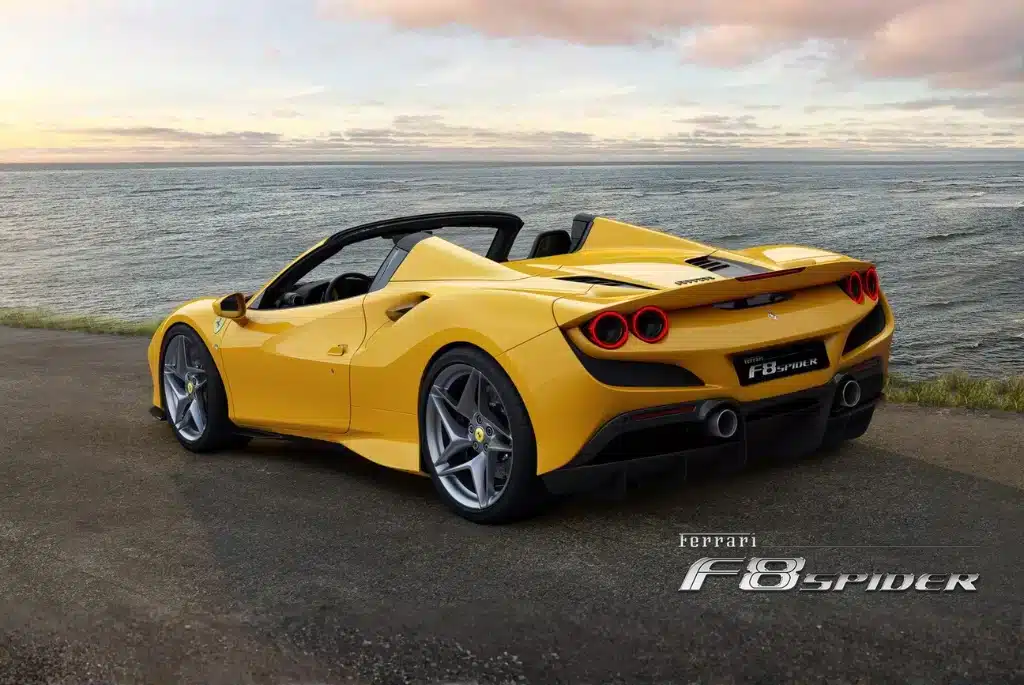
The Ferrari F8 Spider was engineered to deliver performance that places it firmly in modern supercar territory.
Ferrari quotes 0-100 km/h in 2.90 seconds and 0-200 km/h in 8.2 seconds. Top speed is rated at 340 km/h.
Independent testing produced similarly impressive results. Car and Driver estimated a 0-60 mph time of 2.8 seconds and listed a top speed of 211 mph. MotorTrend recorded 0-60 mph in 2.9 seconds and also listed a 211-mph top speed.
The acceleration comes from more than engine output alone. The seven-speed dual-clutch transmission keeps gear changes extremely rapid, while rear-wheel drive maintains the traditional Ferrari performance-car layout.
The Ferrari F8 Spider also benefits from a relatively favourable rear-biased weight distribution. Ferrari’s technical data lists 41.5 percent of the weight over the front axle and 58.5 percent over the rear.
That distribution suits a mid-engine sports car. The rear tyres carry the majority of the powertrain’s load, while the front axle remains relatively light and responsive to steering inputs.
Braking performance is equally important at this level. Ferrari specifies high-performance ABS and EBD, while the braking hardware includes 398mm front discs and 360mm rear discs.
The combination means the F8 Spider is not simply a straight-line machine. Its engineering is designed around acceleration, braking and cornering as a single performance package.
Ferrari F8 Spider: Handling and Driving Dynamics
The Ferrari F8 Spider uses a combination of mechanical grip and electronic control to manage its performance.
E-Diff3 controls the electronically managed differential, while F1-Trac monitors traction and helps maintain stability under acceleration. Ferrari’s Side Slip Control system is designed to allow controlled movement from the rear axle while maintaining a predictable response.
FDE+, or Ferrari Dynamic Enhancer Plus, further contributes to the handling package by using brake pressure to help control yaw during cornering. Ferrari also fitted its SCM-E suspension control system to manage the car’s damping behaviour.
The open-top configuration naturally introduces additional structural requirements. A fixed-roof car benefits from the roof structure as part of the overall body shell, whereas a convertible requires reinforcement elsewhere.
The F8 Spider consequently carries additional mass compared with the F8 Tributo. Ferrari nevertheless engineered the car to retain a very similar performance envelope.
Contemporary testing found the handling to be one of the car’s strongest attributes. MotorTrend described the steering as communicative and the chassis as balanced and composed, while also highlighting the performance of the braking system.
The Ferrari F8 Spider also demonstrates how electronic assistance has changed the character of modern supercars. Earlier high-performance Ferraris often demanded considerable concentration at the limit. The F8’s electronics provide a broader operating window without completely isolating the driver from the mechanical character of the car.
The result is a chassis capable of feeling precise on a demanding road while retaining enough composure for everyday road use.
Ferrari F8 Spider: Interior, Technology and Everyday Usability
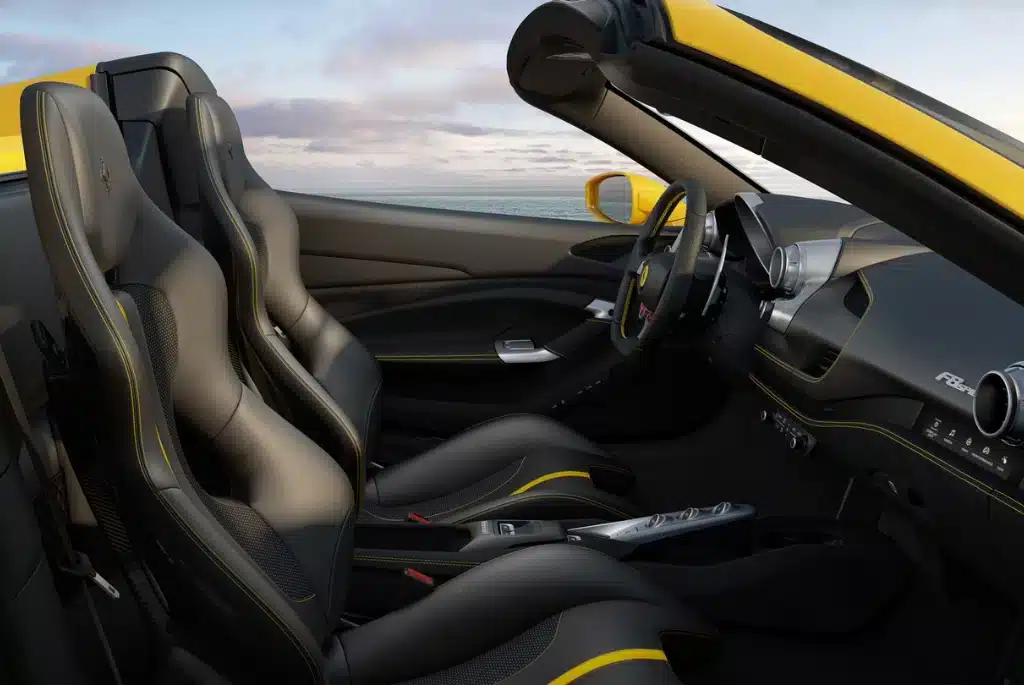
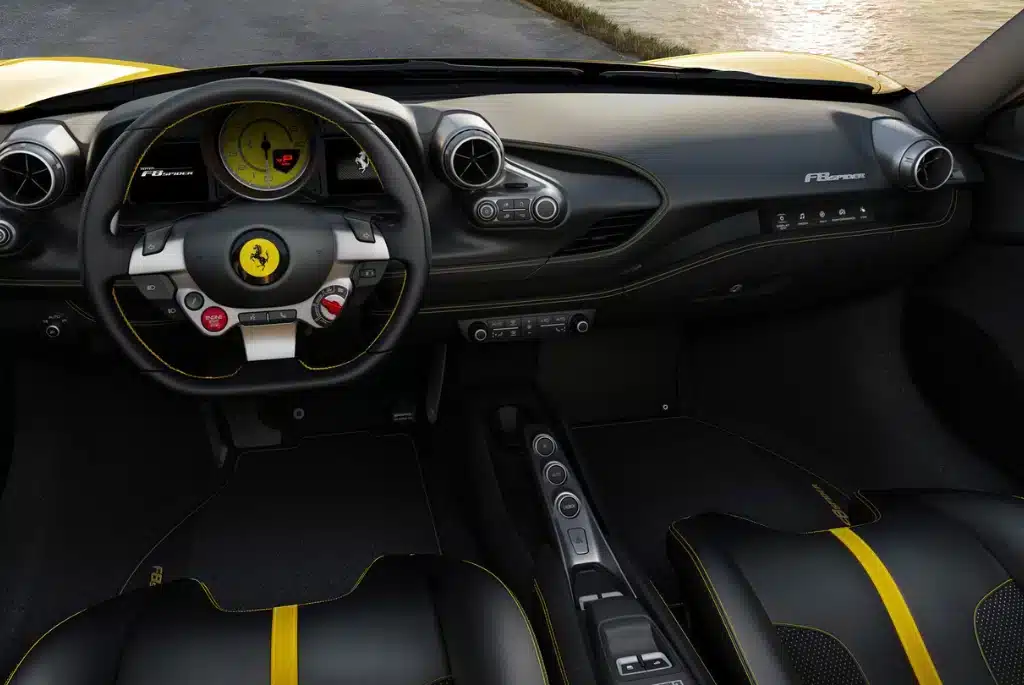
The cabin of the Ferrari F8 Spider remains strongly focused on the driver.
The dashboard, steering wheel and primary controls are arranged around the driving position rather than following the layout of a conventional luxury car. A smaller-diameter steering wheel was introduced for the F8 generation, while redesigned seats further refined the driving position.
The cabin uses premium materials and extensive opportunities for personalisation, but the overall design remains performance-oriented.
The steering wheel carries a large number of controls, while Ferrari’s traditional manettino selector allows changes to the electronic driving systems without requiring the driver to move away from the primary controls.
The Ferrari F8 Spider is also more usable than its extreme performance figures might suggest.
Car and Driver described the cabin as comfortable and reasonably roomy for the segment.
That does not turn the car into a conventional grand tourer. Storage remains limited, with Ferrari’s technical data listing 200 litres of boot capacity. The fuel tank is rated at 78 litres.
The roof mechanism is arguably the most important everyday feature. Its 14-second operating time means the transition between coupe-like and open-top configurations is quick, while the ability to operate it at up to 45 km/h adds convenience in urban conditions.
The retractable hardtop also provides a more insulated cabin when closed than a traditional soft-top arrangement.
That balance explains why the F8 Spider could serve as both a weekend performance car and a high-speed touring machine.
Also read: Toyota Aristo: The Japanese Luxury Sedan That Hid a 2JZ Heart
Ferrari F8 Spider Price and Competition
The Ferrari F8 Spider price placed the car firmly within the upper tier of the modern supercar market.
Car and Driver listed the 2020 Ferrari F8 Spider at a base price of $302,500 in the US. The publication’s tested example reached $396,994 after options.
The difference illustrates the influence of Ferrari’s extensive options catalogue. Carbon-fibre components, special finishes, wheels, seats and other equipment could significantly increase the final transaction price.
The Ferrari F8 Spider price also positioned the model against some of the most capable open-top performance cars of its era.
Ferrari F8 Spider vs McLaren 720S Spider
The McLaren 720S Spider was one of the closest technical rivals. Both cars used twin-turbocharged V8 engines, rear-wheel drive and mid-engine layouts.
The McLaren placed particular emphasis on lightweight construction and chassis engineering, while the Ferrari combined its performance credentials with a more traditional Italian design language and a distinct V8 character.
Ferrari F8 Spider vs Lamborghini Huracán Spyder
The Lamborghini Huracán Spyder offered another interpretation of the open-top supercar. Its naturally aspirated V10 provided a fundamentally different power-delivery character and soundtrack.
The Ferrari’s twin-turbo V8 delivered greater emphasis on torque and low-speed acceleration, while Lamborghini retained the appeal of a high-revving naturally aspirated engine.
Ferrari F8 Spider vs F8 Tributo
The F8 Tributo remained the closest comparison within Ferrari’s own range.
The two models shared the same basic V8 and rear-wheel-drive configuration. The Tributo’s fixed roof offered a lighter and structurally more rigid platform, while the Spider added the ability to remove the roof at the push of a control.
The choice therefore centred less on outright performance and more on the character of the car.
The F8 Spider’s Place in Ferrari History
The Ferrari F8 Spider holds an important position in the history of Ferrari’s mid-engine V8 road cars.
Ferrari’s official historical archive lists the F8 Spider as a 2019 model with a 3,902cc V8, 720 cv and a 340 km/h top speed.
Its significance comes from the maturity of the underlying architecture. The engine concept had evolved through the 458 and 488 generations, while Ferrari’s experience in racing and limited-production performance models contributed to the development of the F8.
The F8 Spider was therefore not an experimental departure. It was a highly refined interpretation of a proven formula.
That makes the car particularly interesting in hindsight. Ferrari had reached a point where a 3.9-litre twin-turbo V8 could deliver 720 cv without hybrid assistance, while advanced electronic systems allowed the performance to remain accessible.
MotorTrend described the F8 Spider as potentially representing the culmination of an era of combustion-only Ferrari sports cars, particularly as Ferrari’s range was moving towards hybridisation.
That historical context does not automatically make the F8 Spider a collector car. It was not positioned as a limited-production special, and its importance is better understood through engineering and timing.
The Ferrari F8 Spider represents one of the most developed versions of Ferrari’s modern twin-turbo V8 formula. It combined a 720-cv engine, sophisticated aerodynamics, rear-wheel drive, advanced electronic controls and a retractable hardtop into a single package.
Its appeal also comes from the balance between extremes. The performance is capable of 340 km/h, yet the cabin can remain comfortable. The chassis can deliver serious cornering ability, yet the car remains usable on public roads. The roof can transform the experience without requiring a completely different vehicle underneath.
A Defining Chapter in Ferrari’s V8 Story
The Ferrari F8 Spider stands as one of the defining open-top Ferraris of the modern era.
Its 3.9-litre twin-turbo V8, 720-cv official output, 340 km/h top speed and sophisticated electronic chassis place it among the most capable combustion-powered Ferrari road cars of its generation.
More significant is the way those elements were combined. The F8 Spider was not merely a faster 488 Spider. It represented years of development distilled into a more precise, more powerful and more technically sophisticated package.
The retractable hardtop added a second personality, allowing the car to move between a focused closed-roof supercar and an open-air performance machine.
As Ferrari’s powertrain strategy moved increasingly towards electrification, the Ferrari F8 Spider came to represent an important closing chapter for the company’s conventional mid-engine V8 formula.
For automotive history, that may ultimately be its most important distinction. The F8 Spider arrived when Ferrari’s combustion technology had reached an extraordinary level of sophistication, making it a fitting final expression of an era defined by the twin-turbo V8, rear-wheel drive and mechanical performance.
About The Author